Old Trafford and the New Trafford Vision: Preserving Manchester United’s Soul While Building for the Future
Manchester United’s proposed 100,000-seat stadium is far more than an architectural project. It is a debate about history, identity, money, matchday culture and the kind of club United want to become.
A stadium that became part of the club’s identity

Old Trafford is not simply where Manchester United play football. For generations of supporters, it has been the physical home of the club’s story. Families have crossed the same roads, climbed the same steps and looked toward the same pitch for decades. Great teams have been celebrated there. Difficult eras have been endured there. Some fans remember their first visit more clearly than they remember the score.
That emotional weight explains why the proposal for a new stadium has created both excitement and discomfort. A modern ground could give United the facilities, capacity and commercial strength expected of one of the world’s biggest clubs. Yet leaving the existing stadium would also mean closing a chapter that began more than a century ago.
The project is often called “New Trafford” in public discussion, although Manchester United officially describes it as the Old Trafford Regeneration project. The final name has not been confirmed. What is clear is the scale of the ambition: a proposed 100,000-seat stadium beside the present ground, supported by a much wider plan to transform the surrounding district.
The birth of Old Trafford

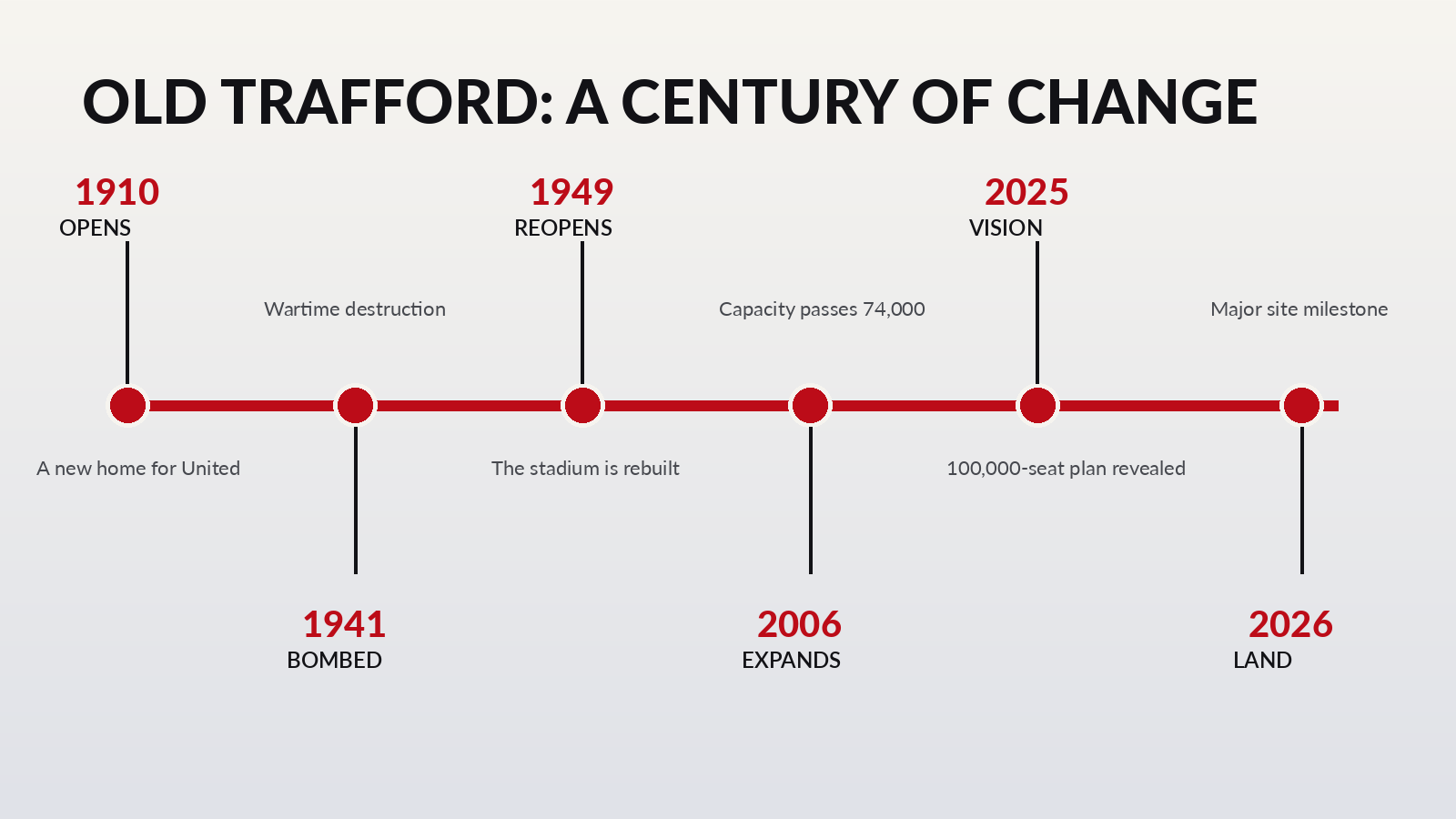
Manchester United moved to Old Trafford in 1910 after outgrowing their previous home at Bank Street. Club chairman John Henry Davies wanted a stadium that matched United’s rising status. Scottish architect Archibald Leitch, one of the most influential stadium designers of his era, was chosen to shape the new ground.
Old Trafford opened on 19 February 1910. Its original capacity was about 80,000, a remarkable figure for that period. The stadium immediately offered United a larger stage, although the opening match ended in a 4-3 defeat to Liverpool. The result mattered less than the message. Manchester United now had a home designed for major crowds and major occasions.
The ground was built close to railway lines, factories and the Manchester Ship Canal. That industrial setting became part of its character. Old Trafford did not rise from a polished entertainment district. It grew from the working landscape of Greater Manchester, surrounded by transport routes, warehouses and communities shaped by industry.
War, destruction and rebuilding
The stadium’s history has never been smooth. During the Second World War, Old Trafford was used as a military depot. A German bombing raid on 11 March 1941 caused severe damage, leaving United without a usable home. The club played many home matches at Manchester City’s Maine Road while reconstruction took place.
Old Trafford reopened in August 1949. That return carried a meaning beyond football. The stadium had survived destruction and been rebuilt, just as the club would later rebuild after other moments of tragedy. Resilience became part of the ground’s identity.
Further changes followed. Floodlights arrived in the 1950s, allowing evening matches. Roofs were extended. Terraces were altered, stands were modernised and safety requirements changed how supporters experienced the stadium. Old Trafford was never frozen in one form. It evolved repeatedly while remaining recognisably itself.
How the Theatre of Dreams grew with United

The nickname “The Theatre of Dreams,” popularised by Sir Bobby Charlton, captured Old Trafford’s relationship with ambition. It hosted the Busby Babes, the rebuilding after Munich and the 1968 European Cup generation. Later, it became the stage for Sir Alex Ferguson’s dominant teams.
As United expanded on the pitch and across the world, the stadium expanded too. The shift to all-seater grounds reduced capacity to roughly 44,000 in the early 1990s. New tiers and corner developments then lifted the total to about 58,000 by 1996, around 68,000 by 2000 and more than 74,000 after the major 2006 expansion.
Those changes helped Old Trafford remain the largest club stadium in England for many years. They also strengthened matchday income during the period when United were becoming a global commercial power. More seats meant more supporters, more hospitality and more revenue to support the football operation.
However, the last major capacity expansion was completed two decades ago. In stadium terms, that is a long time. Rivals have opened new grounds or carried out extensive redevelopment. Expectations have also changed. Supporters now judge stadiums by transport, food, accessibility, concourses, Wi-Fi, hospitality, atmosphere and the quality of the entire day, not only the ninety minutes.
Why the current Old Trafford is under pressure
Old Trafford remains famous, but fame does not remove practical problems. Parts of the stadium feel dated. Crowded concourses can make movement difficult. The roof, drainage and internal facilities have attracted criticism. Accessibility has improved, yet the building’s age and shape still limit what can be achieved.
Expanding the existing stadium is also complicated. The railway line behind the Sir Bobby Charlton Stand restricts development on one side. Rebuilding stand by stand would take years and could reduce capacity during construction. United would face the difficult task of keeping matches running inside a major building site.
A renovation could protect more of the historic structure, but it might still deliver compromises. The club’s feasibility work considered both a rebuilt 87,000-capacity Old Trafford and a completely new ground. By March 2025, United had announced an ambition to pursue the new-build option.
That decision did not mean every detail was settled. A stadium of this scale needs land, planning approval, transport improvements, financing and close cooperation with public bodies. The concept is bold, but bold concepts must survive years of technical and financial testing.
What the proposed new stadium promises

The proposed arena would hold 100,000 spectators, making it the largest football club stadium in Britain. Foster + Partners produced the concept as the centrepiece of a new stadium district. The most striking feature is a vast canopy supported by three tall masts. The central mast has been presented as a landmark that could be seen from far across Greater Manchester.
Inside, the bowl is designed to keep supporters close to the pitch and improve acoustics. Capacity alone does not create atmosphere. Large grounds can feel distant when seating is too shallow or sound escapes. The architects therefore place strong emphasis on steep stands, clear sightlines and a roof structure that holds noise inside the bowl.
The stadium is also intended to work beyond matchdays. Public areas beneath and around the canopy could host shops, food, entertainment, community activity and major events. Instead of becoming active only when United play, the district is meant to attract visitors throughout the week.
Sustainability is another part of the vision. Early plans refer to solar energy, rainwater collection and the use of the Manchester Ship Canal to move prefabricated construction elements. Norman Foster has argued that modular building methods could shorten construction to about five years. That remains an ambition rather than a guaranteed timetable.
A new location beside the old home
United plan to remain at Old Trafford while the proposed stadium is built. This is one of the strongest arguments for constructing the new ground on adjacent land. The team would avoid a long temporary move, while supporters could continue attending matches at the current stadium until the new one is ready.
In June 2026, the club announced that it had secured most of the land needed for the project. The proposed 25-acre stadium site sits roughly 350 metres north-west of Old Trafford. That milestone made the concept more concrete, although a planning application, final funding package and fixed opening date were still required.
Building close to the existing ground also allows the two eras to connect. Supporters would not be moving across the city to a place with no shared memory. The new stadium would remain in Old Trafford, near the canal, railway and streets that have framed United’s home for generations.
The stadium is only one part of a much bigger plan

The wider regeneration could be as important as the stadium itself. Trafford Council and the Greater Manchester authorities have created a Mayoral Development Corporation to guide the transformation of a large area around Old Trafford. Public plans refer to thousands of new homes, major employment growth, better public space and improved transport connections.
Official estimates linked to the regeneration have suggested as many as 15,000 homes and 48,000 local jobs, with wider national employment benefits. Economic modelling has also projected a multibillion-pound annual contribution to the UK economy. Such forecasts are ambitious and should not be treated as guarantees, but they show how much larger the plan is than a football ground.
For local residents, the key questions will concern daily life. Regeneration can create jobs, housing and public investment. It can also raise rents, increase traffic and push existing communities aside if development is poorly managed. The project will need to prove that local people are partners rather than scenery around a global sports brand.
Transport may become the decisive issue. A 100,000-seat venue cannot depend on the same movement patterns as a smaller ground. Rail, tram, bus, walking and cycling routes must handle huge crowds safely. Matchday congestion already affects the area, so the new district will require more than cosmetic upgrades.
What should happen to the existing Old Trafford?

The most emotional question is not how the new stadium will look. It is what happens to the old one. Demolishing every trace would feel like erasing a physical record of Manchester United’s history. Keeping the entire structure, however, may be unrealistic once the club has moved next door.
A thoughtful solution could preserve the most meaningful elements. The Munich clock, the statues, the players’ tunnel, sections of brickwork and the centre-circle location all carry deep significance. Some features could be incorporated into a museum, memorial garden, women’s or academy venue, public park or heritage walk.
United have repeatedly said that the new stadium must retain the club’s soul. That promise will be judged by detail. Heritage cannot be protected by placing a few photographs in a modern concourse. Supporters will expect the story of Old Trafford to remain visible, accessible and emotionally powerful.
The current pitch could become a central public space, allowing fans to stand where generations of players once competed. Even a partial outline of the old stands could help visitors understand the scale and position of the original stadium. Done well, the site could become a bridge between memory and renewal.
Designing a 100,000-seat ground that still feels intense

The size of the proposed stadium creates a difficult design test. One hundred thousand people can generate extraordinary noise, but only when the bowl helps them act as one crowd. Long distances between tiers, large corporate gaps and open roof edges can weaken sound. The best design will keep the stands steep, continuous and visually connected.
Supporters also need clear areas where atmosphere can grow. A large safe-standing section, affordable season tickets and space for fan groups would matter as much as the shape of the roof. Songs spread when vocal supporters are together. They fade when those fans are scattered between premium sections and expensive one-off seats.
The Stretford End has a special place in United culture. A new stadium should create a recognisable home end without turning it into a staged attraction. Its identity must come from the people inside it. Naming, seating policy and access should be shaped with regular matchgoing supporters, not designed only for television images.
Technology can improve the experience without dominating it. Better mobile coverage, faster entry, modern screens and clear information are useful. Constant music, advertising and forced entertainment can have the opposite effect. Football supporters want facilities that work, but they also need moments of tension, silence and spontaneous noise.
What a better matchday should feel like
A new home must also work on an ordinary matchday. Fans should be able to reach their seats with less stress. Signs need to be clear. Food and drink should be easy to buy. Toilets should be clean and close to each stand. The route home should feel safe, even after a late match.
These details may sound small, but they shape how fans judge a ground. A vast roof and tall masts will draw the first look. Good service will decide how people feel after ten visits. The club must test each part of the day with fans of all ages.
The ground should welcome those who have used Old Trafford for years. It should also make space for young fans who are still waiting for a first ticket. More seats can help, but only when prices stay fair. A seat that no local fan can afford adds size without adding soul.
There is also a chance to make the area more active on days when no match is played. A museum, public square, food hall and fan zone could bring life to the site. Local shops and groups should have a role. The district should not feel closed when the team is away.
The financial challenge

External reports have placed the stadium cost at around £2 billion. That figure may change as designs, materials, interest rates and infrastructure requirements develop. The larger regeneration will require far more investment across public and private sectors.
Manchester United must also decide how to pay for its own stadium without weakening the team. Supporters have seen other clubs limit transfer spending while financing new grounds. United’s existing borrowings and recent cost-cutting make the debate even more sensitive.
Several funding routes are possible. The club could use new debt, private investment, naming partnerships, long-term commercial agreements or a mixture of these options. Public money is more likely to support roads, rail, housing and wider regeneration than the stadium bowl itself. Clear separation between public infrastructure and club expenditure will be essential.
Ticket prices are another concern. A 100,000 capacity could increase the supply of general admission seats, but premium hospitality will remain central to the business case. Fans will resist a project that uses heritage as a marketing tool while making attendance less affordable for the communities that created the atmosphere.
Why supporters are divided
Many fans accept that Old Trafford needs major change. They want better facilities, fewer leaks, easier access and a stadium worthy of United’s global standing. A larger capacity could also give more members the chance to attend matches.
Others fear that a futuristic building may feel like a corporate venue rather than Manchester United’s home. Modern stadiums can be impressive yet emotionally neutral. The challenge is to create comfort without sterilising the noise, disorder and tension that make a football ground feel alive.
Consultation therefore matters. Supporters should influence seating design, safe standing, ticket categories, the location of vocal sections, accessibility and the treatment of Old Trafford’s heritage. Decisions made early will shape matchday culture for decades.
The strongest new stadium would not attempt to copy the old ground. It would carry forward its principles: closeness to the pitch, intimidating sound, visible history and a sense that ordinary supporters matter. Architecture can support those qualities, but club policy will determine whether they survive.
Can a new stadium help restore United’s football power?
A stadium cannot score goals or repair recruitment. Manchester United’s football problems since Sir Alex Ferguson retired have come from leadership, planning, coaching and squad decisions. A new home would not automatically return the club to the top of the Premier League.
Still, infrastructure matters. Strong matchday income gives clubs more room to invest. Modern facilities attract sponsors and major events. A world-class stadium can improve the experience of players, staff, supporters and commercial partners. Over time, those advantages can support sporting success.
The danger is allowing the building to become a distraction. United must improve the team while developing the stadium. Supporters will not be satisfied by spectacular architectural images if performances remain poor. The project has to strengthen the football club rather than become a substitute for football progress.
Where the project stands in 2026
By July 2026, Manchester United had moved beyond the earliest concept stage. The club had selected the ambition for a 100,000-seat new build, continued fan consultation, secured most of the required stadium land and confirmed the proposed location beside Old Trafford. The Old Trafford Regeneration Mayoral Development Corporation had also been formally launched to coordinate the wider district.
However, the project was still a proposal rather than a completed commitment. Key questions remained around planning approval, construction contracts, infrastructure, financing and the precise future of the existing stadium. Early references to a five-year build and a possible opening around the start of the 2030s should be understood as targets.
That distinction is important. Stadium projects often change as engineering work, budgets and public consultation become more detailed. Capacity, shape, timelines and surrounding development may evolve before construction begins.
A choice between nostalgia and responsibility
The debate is sometimes framed as history against progress. In reality, Manchester United must respect both. Refusing to change would not preserve Old Trafford forever. Age, maintenance and modern standards will continue to create pressure. Moving carelessly, on the other hand, could damage something that cannot be rebuilt once lost.
The responsible path is to create a new stadium that feels rooted in place. It should be ambitious without becoming detached from supporters. It should improve the local area without displacing the people who live there. It should honour Old Trafford through meaningful preservation, not empty slogans.
Manchester United’s present home survived war, reconstruction, tragedy, expansion and more than a century of football. Its value comes from what happened inside it and from the people who filled it. A new stadium can become special, but only time and shared experience can turn a building into a home.
How a new ground becomes a real home
The best test is simple. Does the new ground still feel like home when the rain falls, the team is a goal down and the crowd must lift the players? On such nights, fans will not care about a grand plan on a screen. They will care about the view, the sound and the person next to them.
Old Trafford earned its name through time. The next ground will have to do the same. It may look bold from day one, but trust will grow match by match. Cup wins, late goals and shared pain will give it meaning. That process cannot be rushed.
For that reason, the club should avoid claims that the new site will replace each old feeling at once. It will not. The aim should be to give fans a strong place where new memories can begin, while the old ground is kept with care.
The future of the Theatre of Dreams

Old Trafford will always be part of Manchester United, even if the first team eventually walks into a new ground a few hundred metres away. The challenge is to ensure that the move feels like a continuation rather than a break.
A 100,000-seat stadium could give United a stage equal to their global support. The surrounding regeneration could reshape a neglected part of Greater Manchester. Better transport, housing, public space and employment could leave a legacy far beyond football.
Yet success will be measured in human terms. Can families still afford to attend? Will the loudest supporters remain close to the pitch? Will local residents benefit? Can a child entering the new stadium feel the same wonder that generations felt when they first saw Old Trafford?
Those questions matter more than the height of the masts or the size of the roof. Manchester United are not merely planning a stadium. They are deciding how to carry more than 115 years of memory into the future. If the club protects that memory while building boldly, the next Theatre of Dreams could honour the old one rather than replace it.
Sources
This article draws on official club, local-authority and news-agency material available in July 2026.
• Manchester United Investor Relations: History of Old Trafford
• Manchester United: Old Trafford Regeneration hub
• Manchester United: New 100,000-seat stadium ambition
• Manchester United: Land secured for the proposed stadium
• Manchester United: Proposed new stadium location
• Trafford Council: Old Trafford Regeneration Mayoral Development Corporation
• Reuters: Manchester United unveil £2 billion stadium plan
Football Vows •
Discover more from Football Vows | Fifa Worlds
Subscribe to get the latest posts sent to your email.